
Flash! Ah-ah! Will it save every one of us?
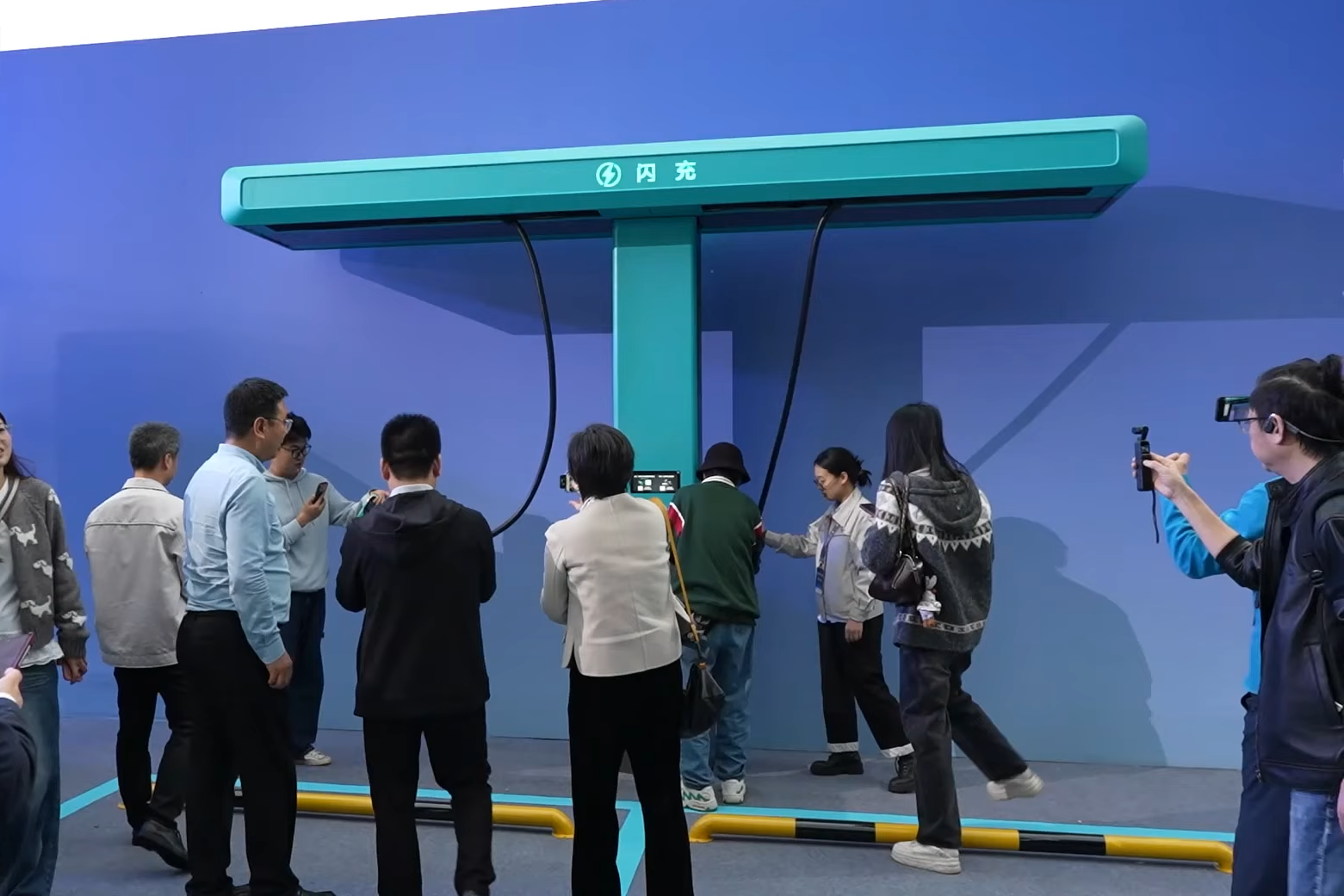
A BYD Flash Charger. Image: 中国新闻社 (China News Service), via Wikimedia Commons, cropped, licensed under CC BY 3.0 (creativecommons.org/licenses/by/3.0)
Flash charging has landed in the UK. The MW output draws all the attention - but that MW is a burst from a battery, not a flow from the grid, and it's the flow hiding behind it that remains decisive.
Flash charging is here - like now
BYD gave Flash charging its UK debut at Uxbridge in June, then brought it to Goodwood for the Denza Z’s launch - 10-70% in around five minutes, live, in public. It’s impressive. I did not foresee mad LFP cells with mad C-ratings arriving so swiftly from China, nor their impact as buffers on the charger side.
C-Rating 101: C-ratings measure how fast a battery charges - charge a 100kWh battery at 100kW and you have 1C.
Most EVs in Europe today charge at 2-3C; a handful of Chinese models already ship past 5C.
These BYD Blade cells are rated at 10C - 100kWh charging at 1,000kW - incredible.
But as I’ve long said, the constraint on fast charging is more on the grid side than the car side. Cars charging uber quickly is exciting; dispensing 1MW from a fraction of that as grid connection is the more interesting element - a burst dispensed from a mere trickle of a flow.
Long term degradation at these rates is TBC - and it’s the buffer cells that would face the harder duty cycle, daily on a forecourt. But assuming BYD is right that it can be managed: game changer. Bravo (or hǎo!), China.
So is the future of petrol station style recharging just around the corner?
Um. I’m still not so sure.
My doubt was always the cost and convenience combination. An additional trip to charge will always lose to the great EV advantage of charging where you park, and destination AC (work, home, car park) comes with lower infrastructure costs and lower prices - UK DC rates run ~10x home charging for exactly this reason. And while public AC charging is not as cheap as I’d like, I’ve covered the reasons here.
However, 10C buffer cells mean: petrol-style dwell times, smaller grid connections, so lower grid costs. So it warrants taking it seriously.
Energy burst vs energy flow
A grid connection delivers a flow - constant, limited by whatever your cable and your DNO agreement allow. A high C-rating battery buffer saves that flow up and releases it as a burst - huge, and brief. The burst is just a flow you've paid to store and dump on demand.
So the buffer changes when the energy arrives, never how much. Over any stretch longer than the burst, the flow is all you have. Which means the shape of your demand decides everything. Bursty, sporadic demand? The buffer is a gift. Sustained demand? The burst runs dry and you're left with the flow you started with.
Busy forecourt, punishing numbers
This impressive and informative video from Kyle Conner shows the model BYD are deploying: two ~190kWh Blade 2.0 buffer cabinets (~380kWh total) on a grid connection of 100-560kW, feeding ~1MW per gun. Their best-case connection - the full 560kW, in most of the UK already a violently expensive and painful thing to secure - delivers a max 13.4MWh (~50k car miles) a day running flat out around the clock. Everything that follows is just a question of how you parcel that out.
First, assess the event they demonstrate. “Ready in 5” is 10-70%, which on the launch Z9GT’s 122kWh (flash-spec) pack is ~70kWh in five minutes (Uxbridge actually dispensed ~106kWh). A flagship capability demo rather than a claim about typical events, granted - but it’s the experience being sold. At petrol-station-style peak, ~70kWh every ~5 minutes on each gun pulls ~1.7MW against 0.56MW flowing back in. The buffers drain in ~20 minutes - three or four cars per connector - and from then on the station is a 2 x 280kW charger delivering the traditional ~20 minute charge event. Refilling the buffer battery from flat takes ~40 minutes of quiet that a busy site shouldn’t have.
Mitigating in BYD’s favour, because UK DC charging sessions currently average ~30kWh - a product of pricing at ~79p/kWh or higher. Flash will likely pull that up (when it’s this quick, the time poor will feast), while price still bounds it, so call it 45-50kWh as an average. Their own numbers quietly agree: 13.4MWh spread across their claimed 200–300 cars a day implies 45–65kWh sessions - and only if the site runs flat out, even at 4am. Even here the peak hour still breaks - just slower. It's the faff that protects them: connector swaps - unplug, drive off, park, plug, authenticate - throttle each gun to ~475–500kW, so a saturated pair pulls ~1MW against 560kW in and the buffers last 50 minutes to an hour. Strip the swap gaps to a minute with plug-and-charge and true forecourt flow - exactly the experience being sold - and they're gone in ~25.
Sustained demand collapses back to the flow. A busy forecourt is definitionally sustained demand. The burst is the wrong tool.
The burst costs bucks
Of course, you can add more battery buffer and thus extend your peak capacity. But you can’t do this for free. Batteries are cheaper than grid and trending cheaper, but they aren’t free - every kWh is more infrastructure cost. And every buffered electron makes a round trip through a battery at 5-10% loss, plus the parasitic load of keeping a 10C pack thermally comfortable on a forecourt. These costs land on the kWh rate.
Arbitrage
BYD’s actual economic pitch is avoiding grid capex plus arbitrage: fill the buffer overnight when electrons are cheapest, skip the dedicated substation, and (BYD claim) cut installation capex by ~60%.
It’s a real argument. But the arbitrage benefit scales with buffer size (energy), not burst size (power): 380kWh of cheap overnight electrons covers seven or eight cars of the morning at our ~45-50kWh average, and car nine pays the day rate. Hold the buffer fixed and the cheap-energy story spreads ever thinner as throughput grows; grow the buffer and the capex grows instead. Same shape as the physics - victim of its own success.
Pricing
With BYD now deploying the system, we can assess real pricing. BYD are targeting “sub-50p”, but this is the subsidised charging for BYD customers. Non BYD drivers will pay more typical DC costs (probably >70p/kWh - i.e. expensive petrol type prices - albeit perhaps a little below the cost of DC CPO networks). It’s worth noting that this is materially worse than what Tesla offer through their own subsidised Supercharger network. So for all the innovation, this is marginally more competitive than DC networks, but isn’t crushing it on costs here - and while amortising the costs over super high utilisation might help lower them - we’ve shown it adds infrastructure costs in the form of buffer batteries.
Which matters if you think we’re going to use these like petrol stations. There’s no obvious path to making these affordable in the UK like AC can be, so it’s a tough sell offering petrol prices (and the wretched proposed eVED fee).
Convenience for drivers
And set cost aside for a moment. Conventional <400kW DC chargers are much slower than Flash chargers, but - as a private driver - I genuinely don’t care at all. If I’m using DC (a handful of times a year) I’m happy to stop for 20-30 mins - it happens during the loo-and-coffee stop anyway. Going super fast means I have to watch the car charge then go and park - a net loss of convenience (and peak Rapid Charge Paradox). And I doubt I’m alone in that take. “Faster is always gooder” is an opinion held mostly by ICE car drivers, not experienced EV drivers.
Faster isn’t always better - but it is still always expensive
So, we may have found a way to offer very fast charging intermittently without devastating the price, but the original problem stands - if you make en-route charging fast, you load infrastructure cost onto the per kWh rate. AC charging available at a driver’s destination remains the more economic and convenient choice for the vast majority of people’s charging.
Thinking beyond an electrified petrol station reveals great value
BUT - goodness me this is impressive tech, and bursty charging will be superb where dwell time is scarce and demand sporadic. Think depot fleets with minimal downtime - HGVs, emergency response vehicles - can dispense at ~1MW from batteries restocked through comparatively modest connections, and those same batteries earn their keep in flex markets between charge events. The shape scales too: Norwegian ferries already fast-charge at berth from shore-side buffers, and electric aviation, when it arrives, has a similar profile.
Sporadic bursts drawn from a thin flow: that's the sweet spot. It just isn't the petrol forecourt.
So - we have a game changer on our hands. For real. Just maybe not quite so much, for the use case it’s being sold with.
Gordon’s RCP’s alive!
So we can conclude Flash will save some of us, but - yes - the Rapid Charge Paradox remains valid, en-route speed always costs, and where you can charge on a flow instead of a burst, you should. Good news for anyone with practical EV charging or infrastructure challenges to untangle. If that’s you, please get in touch at hello@rapidchargeparadox.com.
